Ground-Nesting Bees Q&A
Southwest Yard & Garden
By Bethany Abrahamson, Dr. Joanna Bloese, and Dr. Joanie King

A bee peeking out of its nest. Photo credit: Joanie King, NMSU.
QUESTION: What are ground-nesting bees, and how are they different from honey bees?
ANSWER: While we love to see native bees flying around pollinating our plants, the truth is native bees actually spend very little of their life among the flowers. Most of their lifespan is spent out of sight. Around 70% of North America’s native bee species make homes for their larvae underground. Bees go through complete metamorphosis, changing throughout their lifetimes from egg to larva to pupa to adult. The larval stage can be relatively short, as in the case of bumble bees, or go on for months. At this life stage, bees are very vulnerable and need protection, so adults build nests furnished with pollen for them to grow in safety. Adults spend part of the summer furnishing their nests, then rely on the larvae in those nests to survive through the rest of the year until they can pupate and emerge in the spring as adults. In the case of bumble bees, queen bees spend the summer gathering food and mating in a small colony, then find a place to overwinter (males and worker bees don’t survive). Come spring, they will emerge to feed, pollinate, and make nests to lay eggs for the next generation to emerge and start the cycle over.
Other critters make holes in the ground as well. Cicada killer wasps, for instance, dig burrows one and a half inches wide!
Cicada killer wasps benefit the landscape by preying on pest insects and visiting flowers. Photo credit: Jessica Louque, Smithers Viscient, Bugwood.org, CC BY-NC 3.0 US.
QUESTION: How can I recognize a bee nest?
ANSWER: Bee nest entrances are often about a quarter of an inch wide (larger than ant hill entrance). You are most likely to find them in areas that are warm, sunny and dry, with well-drained soil and low organic matter. You're also more likely to find bee nests in areas where the soil remains undisturbed, as some species prefer open spaces that receive plenty of sunlight and lack grass or mulch cover. Other bees prefer a few pebbles mixed in with the dirt, or sparse areas in lawns (leading some to blame the bees for causing the damage to their lawn, when in reality, bees choose the damaged area as a good nest site).
Like most insects, ground-nesting bees tend to make use of locations that best meet their ecological needs. Bees native to arid and semi-arid environments are likely to avoid nesting directly in areas that are consistently moist and/or heavily mulched, such as an irrigated garden bed, while taking advantage of dry edges, compacted pathways, ditch banks, or undisturbed soil nearby.
Ground-nesting bees are not social in the same way that honeybees are but may nest together in groups while they lead their solitary lives furnishing their nest with pollen for their own offspring. So, you might see several holes grouped together in an area.
It can be hard to tell what kind of critter might be nesting in your yard, so you may need to observe bee activity in and around the nest to be sure. If you see holes in the bare soil in your yard, spend a few minutes observing them in the warmth of the day. The key is to catch the owner as they are arriving or departing. Be patient and keep an eye on the holes for residents. Most native bees are unlikely to show aggression and will stay in the nests for only a limited period, allowing you to make your observations. You may also see low-flying guard bees patrolling for intruders such as cuckoo bees, that like to parasitize solitary bee nests for their own young to thrive. To create a visual cue without causing too much disturbance to the owner, drop a small leaf over the hole on a windless day, then sit back and see who arrives to clean house.
Sightings of ground-nesting bees may be made from March to September; sightings can include a variety of bees. ProjectGNBee allows the public to contribute pictures of ground-nesting bees with their nests to iNaturalist, in the hopes that researchers learn more about these important creatures. I recommend searching for verified or research-grade identifications of New Mexico bees with their nests, looking like first-time homeowners standing proudly outside their new digs.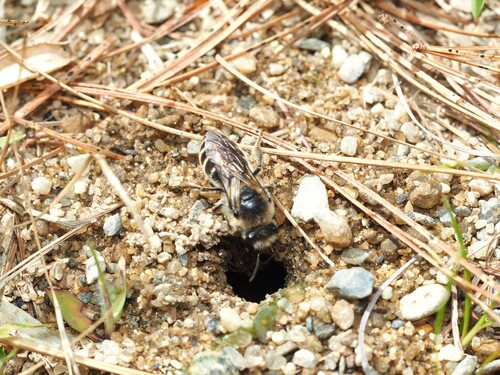
QUESTION: How can I make a home for ground-nesting bees?
ANSWER: Unlike honey bees, many native bee species are solitary and nest in the ground. To make a home for them, provide bare patches of dirt. Most gardening advice stresses the need for covering bare soils with mulch, gravel or grass, but even small areas of uncovered soil can be good nesting sites for local native bees. However, this does not mean that one’s yard must look unkempt. Instead, consider retaining a couple of sunny and well-drained spots with little to no vegetation, ideally near gardens, flowering plants, or any other areas that do not get tilled often.
Her are some tips to encourage soil-nesting bees in your yard:
- Retain several small patches of sunny, well-drained soil.
- Leave some areas un-mulched.
- Dig less often in areas where you see that bees are active.
- Refrain from treating blooming plants (including weeds) with insecticides, especially when bees are active.
- Grow plants that bloom during the spring and fall.
Nesting spots are extremely variable in many ways, including size, number of young, location, soil type, and proximity to specific plants. Providing a variety of habitats is always a good option.
QUESTION: What are some different soil-nesting bees, and what do their nests look like?
ANSWER: Here are just a few of the ground-nesting bees you might see in New Mexico:
Bumble bees (Bombus sp.): Bumble bee nests may be found in hay bales, or on the ground in pre-existing rodent cavities. Some may even build their nests out of natural materials:

A bumble bee nest made out of feathers and moss. Photo credit: Mara Koenig, U.S. Fish and Wildlife Service - Midwest Region, via Wikimedia Commons, public domain.
Mining bees (Andrena sp.): You are likely to find mining bees making their communal nests in the early spring. Some of these bees have low fecundity, or produce very few offspring, so it is even more important to leave their nests alone so that they can complete their life cycle. Look for furry patches, aka facial foveae, between their eyes and around their antennae. Mining bees include the super-tiny Perdita bees which are smaller than rice!

Andrena bee guarding her nest. Photo credit: Whitney Cranshaw, Colorado State University, Bugwood.org, CC BY-NC 3.0 US.
Halictid bees: This diverse family of bees includes cuckoo, sweat, furrow, and alkali bees. They are shiny green or blue, or rather nondescript. Bees in this family may form nests in clay or sandy soils, and some prefer pebbles. Cuckoo bees steal the nests of others, so you might see one of these bees getting chased off from a nest by a guard bee!
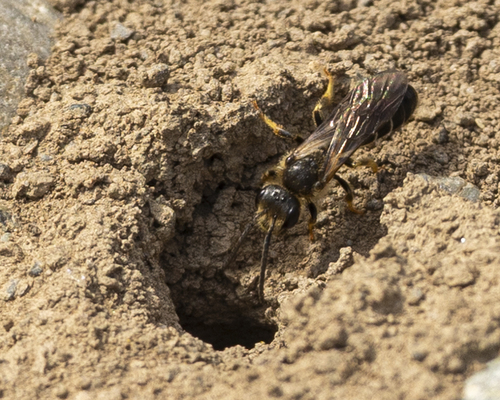
Orange-legged furrow bee, Halictus rubicundus. Photo credit: Kris Ethington, iNaturalist, CC BY-NC 4.0
Digger bees (Anthophora sp.): These bees may make little cinder-cones when they dig their nests.

Anthophora ursina. Photo credit: Jerry A. Payne, USDA Agricultural Research Service, Bugwood.org, CC BY-NC 3.0 US.

Nesting site of Genus Anthophora. Photo credit: Howard Ensign Evans, Colorado StateUniversity, Bugwood.org, CC BY-NC 3.0 US.
Chimney bees (Diadasia sp.): Nests of these bees can be easy to spot, as they make little battlements around their nest entrances:

These Diadasia chimney bees aggregated their nests together. Photo credit: Whitney Cranshaw, Colorado State University, Bugwood.org, CC BY-NC 3.0 US.
QUESTION: Should I be concerned about the presence of soil-nesting bees in my yard? When is action necessary to remove bees and their nests?
ANSWER: Since bees provide so many benefits to our landscapes, it is usually best to leave sites used by ground-nesting bees alone. Action may be needed if the bees are in high traffic areas where human/pet activity is frequent throughout the year, if the bees are entering buildings, or if people allergic to bee stings are often present.
For more information on ground-nesting bees:
Bertagnolli, V. (2025). Spring has sprung and so have the (ground-nesting) bees. Clemson Cooperative Extension Home and Garden Information Center. https://hgic.clemson.edu/spring-has-sprung-and-so-have-the-ground-nesting-bees/
Echeverri, S. (2024). Clear Space for Bees: Why Pollinators In Your Yard Need Access To Bare Ground. Xerces Society Blog. https://xerces.org/blog/clear-space-for-bees-why-pollinators-in-your-yard-need-access-to-bare-ground
Grasswitz, T.R. and D.R. Dreesen. Pocket Guide to the Native Bees of New Mexico. New Mexico State University and Natural Resources Conservation Service. https://pubs.nmsu.edu/bees/
Ground Nesting Bees. https://www.gnbee.org/
Levenson, H. (2025). Ground-nesting bees- what to look for and what species to expect. NC State Extension. https://pollinators.ces.ncsu.edu/2025/03/ground-nesting-bees-what-to-look-for-and-what-species-to-expect/
Mason, L. (2023). Where to bees go in the winter? From the Hort Desk, Colorado State University Extension Arapahoe County. https://arapahoe.extension.colostate.edu/2023/01/05/from-the-hort-desk-9/
“Family Halictidae – Sweat, furrow, Nomiine, and short-faced bees.” (2023). Bugguide.net. https://bugguide.net/node/view/128
Russell, H. (2017). Solitary bees in yards a temporary nuisance. Michigan State University Extension. https://www.canr.msu.edu/news/solitary_bees_in_yards
Womack, J. (2025). Seventy percent of bees live in nests underground, not in hives. Oregon State University. https://extension.oregonstate.edu/catalog/pub/em-9508-seventy-percent-bees-live-nests-underground-not-hives
For more gardening information, including decades of archived Southwest Yard & Garden columns, visit the NMSU Extension Horticulture page (http://desertblooms.nmsu.edu/), follow us on social media (@NMDesertBlooms), or contact your County Extension office (https://extension.nmsu.edu/county.html).
Bethany Abrahamson is a Cooperative Extension Agriculture Agent for Sandoval County. Joanna Bloese is an Extension IPM Specialist for NMSU. Joanie King is an Extension Entomology Specialist for NMSU.


.jpg)
Comments
Post a Comment